
Hands-on operation
Participants immediately discover how input, movement, and feedback relate to one another.
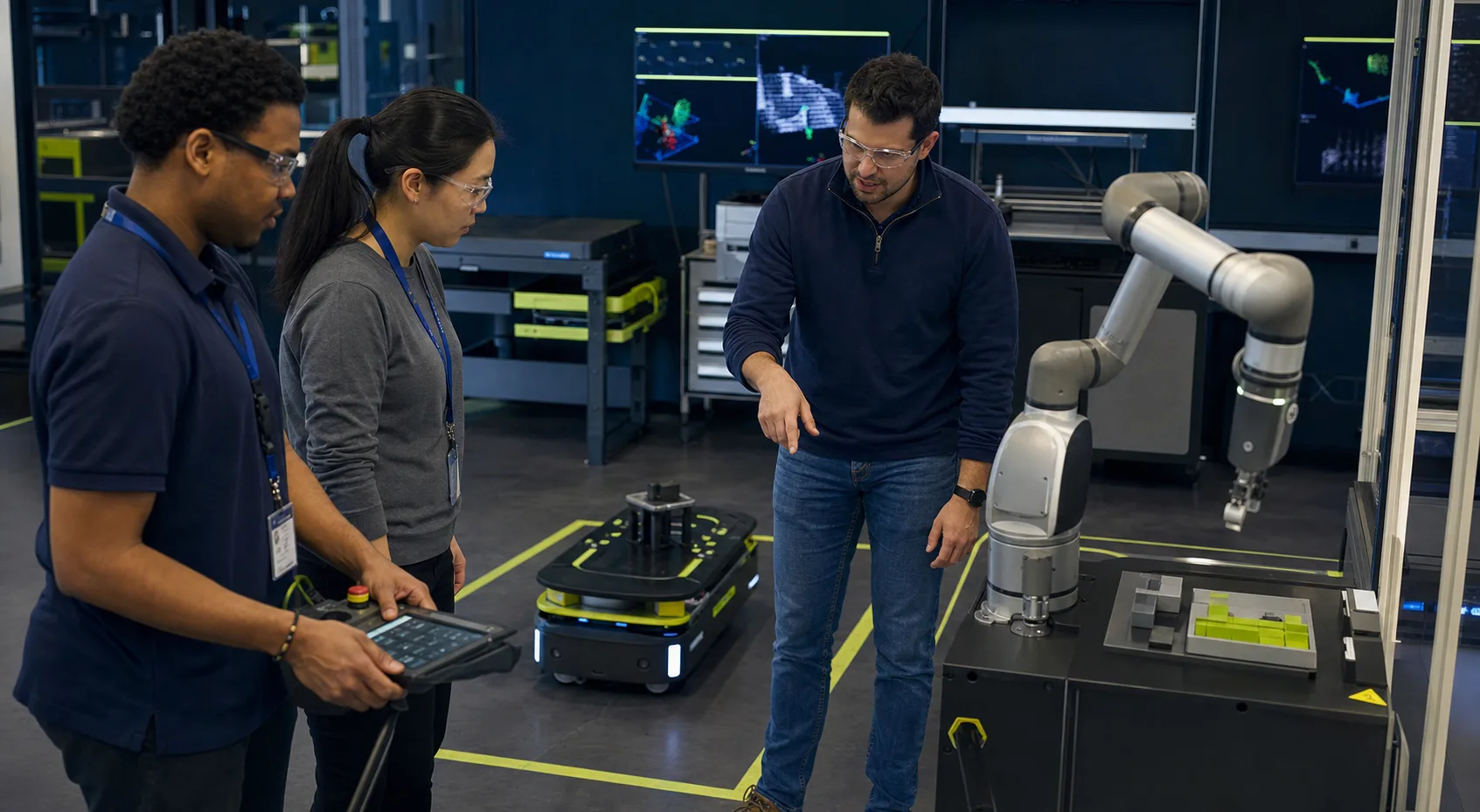
Robotics Mission Lab makes robotics, operation, and human-machine collaboration safe and tangible within a guided learning, demonstration, and training environment.
From movement to meaning
A robot is more than hardware. The experience comes to life when participants see how controls, sensors, task logic, safety, and collaboration affect one another.
Participants immediately discover how input, movement, and feedback relate to one another.
An assignment is translated into steps, conditions, and controlled execution.
Operator, observer, and coordinator work on one task from different roles.
The same assignment can be safely repeated with an adjusted approach.
Participant-centered
Each step adds technical insight, responsibility, and collaboration.
Learn about the assignment, work zone, roles, and agreed boundaries.
Examine the drive system, sensors, controls, and available feedback.
Operate the robot and experience how precision and environment affect the outcome.
Translate an assignment into a logical sequence of actions and checkpoints.
Execute the task with clear roles, communication, and supervision.
Review behavior, decisions, and deviations, and improve the next execution.
Integrated robotics
Modules are selected based on the target group, location, and task. Their value lies in the integration of physical systems, simulation, roles, and facilitation.
Mobile platforms for navigation, operation, and task execution.
Controlled movements, positioning, and simple manipulation tasks.
Make distance, position, and surroundings visible to participant and system.
Explore behavior first and prepare repeatable assignments.
Controls, status information, and supervision from a clear workstation.
Assemble actions, conditions, and sequences in an understandable way.
Review progress, observations, and evaluation as a team.
Skills behind the robot
Robotics reveals how technology, human action, and collaboration determine the outcome together.
Carefully prepare and execute movements and assignments.
Understand how hardware, software, and sensors affect one another.
Deliberately distribute tasks and supervision between participant and system.
Coordinate concisely and clearly between different roles.
Use deviations to improve the task, controls, and collaboration.
Versatile applications
The same modular foundation is configured differently as the target group, context, or program objective changes.
For orientation, guided training, and programs that make technology safe and tangible to experience.
Explore applications for Defense and securityFor technology education, career orientation, and hands-on programs at secondary vocational and higher-education levels.
Explore the education applicationFor open days, events, and programs where participants explore new technology themselves.
Discuss a demonstrationScalable for each location
The setup is based on objectives, space, target group, and required capacity, and can be adapted or expanded later.
A portable configuration for demonstrations, events, and temporary programs.
A permanent setup in an existing classroom, innovation center, or training environment.
A complete environment with multiple stations, briefing facilities, shared visualization, and facilitation.
From objective to operation
We connect technology to a suitable program, facilitation, and a predefined evaluation approach.
Explore the pilot programDefine the objective, target group, and intended experience
Design modules, scenarios, and configuration
Prepare the space, technology, and facilitation
Commission the environment in a controlled manner
Evaluate delivery and determine next steps
Safety and customization
Robotics Mission Lab is carefully configured around your location, target group, and ambitions. Our proposal specifies how robots, scenarios, facilitation, and safety measures come together in a safe, purpose-built learning and training environment.
Discuss your target group, location, and program objective, or validate the proposed approach through a focused pilot first.