
Perceive
Discover how sensors measure an environment and what information may be missing.
Autonomous Mission Lab makes sensors, system behavior, and human supervision understandable through safe, repeatable scenarios.
From sensor to behavior
Participants examine not only what an autonomous system does, but also the data, rules, and boundaries that determine its behavior.
Discover how sensors measure an environment and what information may be missing.
Reveal how conditions and priorities lead to system behavior.
Determine when an operator observes, intervenes, or stops execution.
Repeat the same assignment with different data, settings, or conditions.
From data to action
Participants follow the chain from initial perception through execution and shared evaluation.
Define the assignment, environment, roles, and system boundaries.
Examine what different sensors perceive and how reliable that information is.
Translate observations into position, map, route, and relevant obstacles.
Define priorities, conditions, and moments for human intervention.
Observe how the system navigates, responds, and handles change.
Compare expectations, telemetry, and outcomes, then adjust the approach.
Visible autonomy
Autonomy is built step by step. Participants can follow perception, decision logic, execution, and human supervision as an integrated process.
Examine different forms of perception and their limitations.
Show how raw data is interpreted.
Track position, routes, and obstacles within the scenario.
Configure conditions, priorities, and boundaries clearly.
Deliberately practice oversight, intervention, and handoff.
Observe system status and events during execution.
Safely repeat scenarios before considering physical deployment.
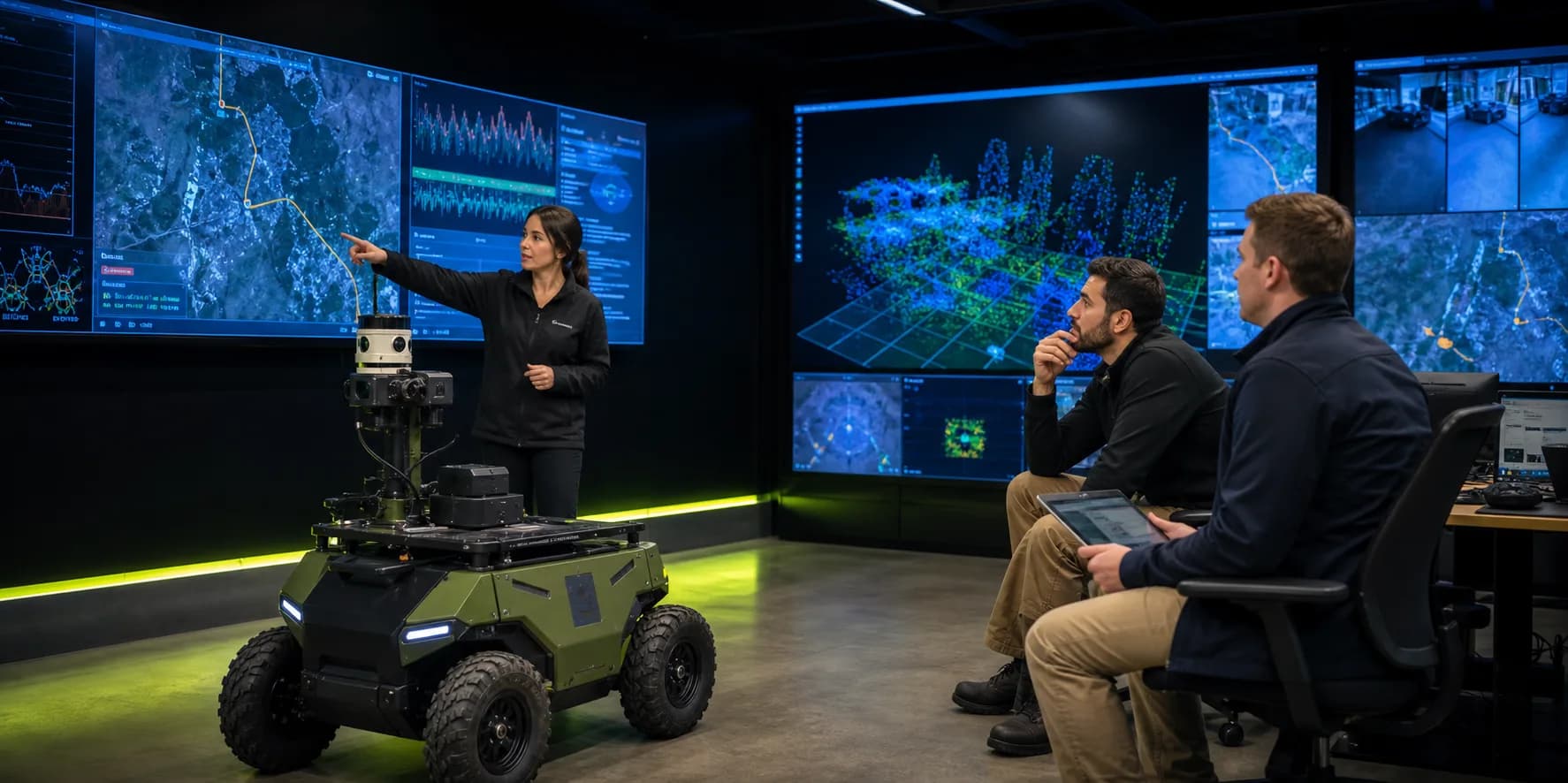
Understand before trusting
Participants learn to assess system behavior critically and understand their own role as supervisors.
Identify, compare, and contextualize observations.
Recognize relationships between sensor, rule, environment, and execution.
Deliberately determine when observation, intervention, or stopping is required.
Form expectations for changing conditions.
Substantiate behavior with observations and available telemetry.
Versatile applications
The same modular foundation is configured differently as the target group, context, or program objective changes.
For orientation, guided training, and programs that make technology safe and tangible to experience.
Explore applications for Defense and securityFor technology education, career orientation, and hands-on programs at secondary vocational and higher-education levels.
Explore the education applicationFor open days, events, and programs where participants explore new technology themselves.
Discuss a demonstrationScalable for each location
The setup is based on objectives, space, target group, and required capacity, and can be adapted or expanded later.
A portable configuration for demonstrations, events, and temporary programs.
A permanent setup in an existing classroom, innovation center, or training environment.
A complete environment with multiple stations, briefing facilities, shared visualization, and facilitation.
From objective to operation
We connect technology to a suitable program, facilitation, and a predefined evaluation approach.
Explore the pilot programDefine the objective, target group, and intended experience
Design modules, scenarios, and configuration
Prepare the space, technology, and facilitation
Commission the environment in a controlled manner
Evaluate delivery and determine next steps
Experiment safely with autonomy
Autonomous Mission Lab is configured around your objectives, environment, and desired level of autonomy. Participants examine system behavior in safe, repeatable scenarios and learn how human oversight supports reliable application.
Discuss your target group, location, and program objective, or validate the proposed approach through a focused pilot first.