
Purposeful
Every experience begins with a recognizable assignment and a clear learning or demonstration objective.
Drone Mission Lab is a modular learning, simulation, and training environment where participants experience drones, VR, mission planning, and command and control as one integrated system.
Mission-based learning
Drone Mission Lab connects technology to a concrete assignment. Participants do not simply watch a demonstration; they take on a role in a shared mission.
This makes operation, observation, communication, teamwork, and reflection part of one integrated experience.
Every experience begins with a recognizable assignment and a clear learning or demonstration objective.
Participants work from different roles toward one shared mission picture.
Technology becomes understandable when participants operate, observe, and act firsthand.
Scenarios can be safely repeated and adapted to the target group, level, and available time.
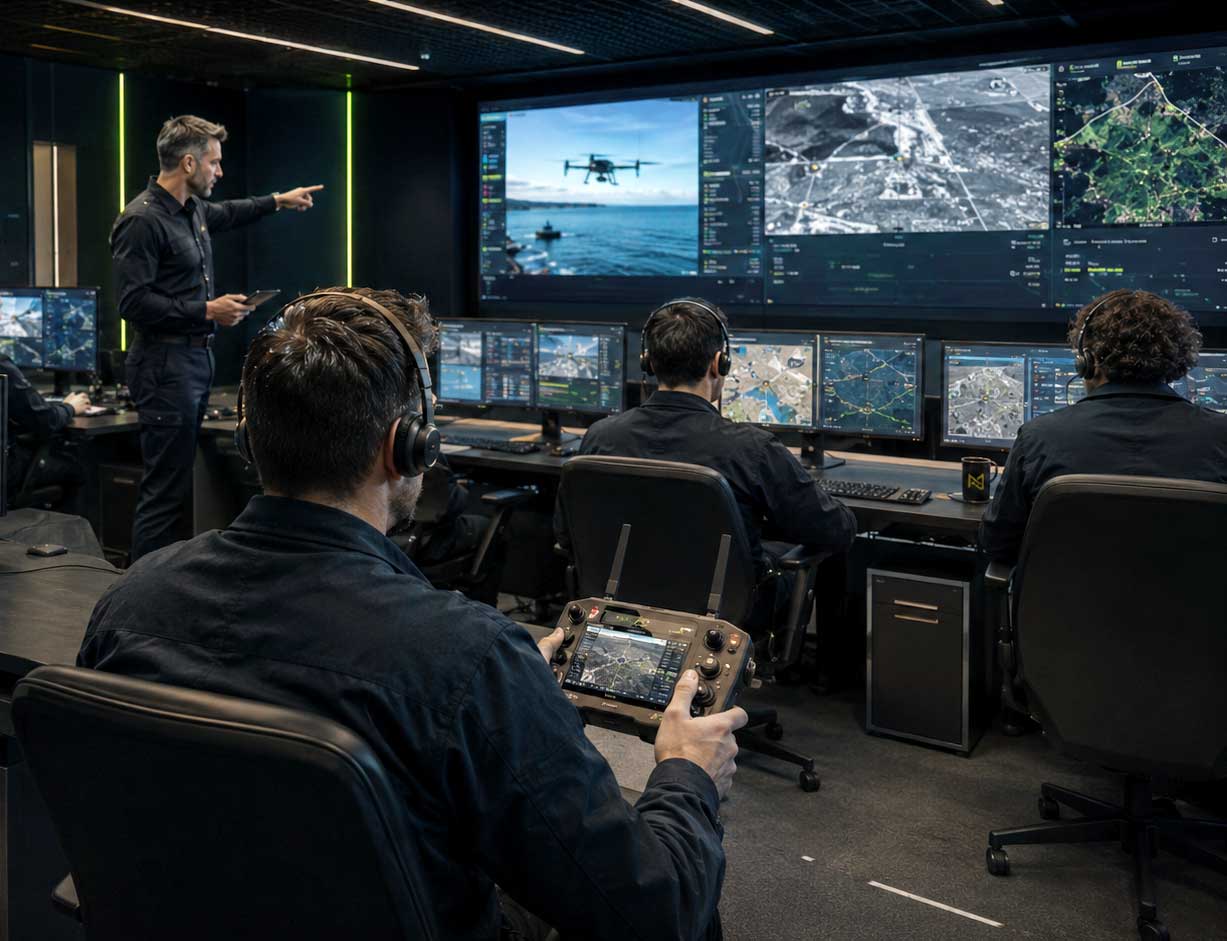
Participant-centered
Each phase adds new information, responsibility, and collaboration. The exact setup is adapted to the target group and program.
Learn about the assignment, context, and shared objective.
Determine who operates, observes, communicates, and maintains oversight.
Explore the scenario, choose a route, and agree on decision points.
Execute the assignment with realistic controls and immediate visual feedback.
Share observations, coordinate actions, and adapt the approach as a team.
Review decisions and observations and translate them into the next exercise.
Integrated technology
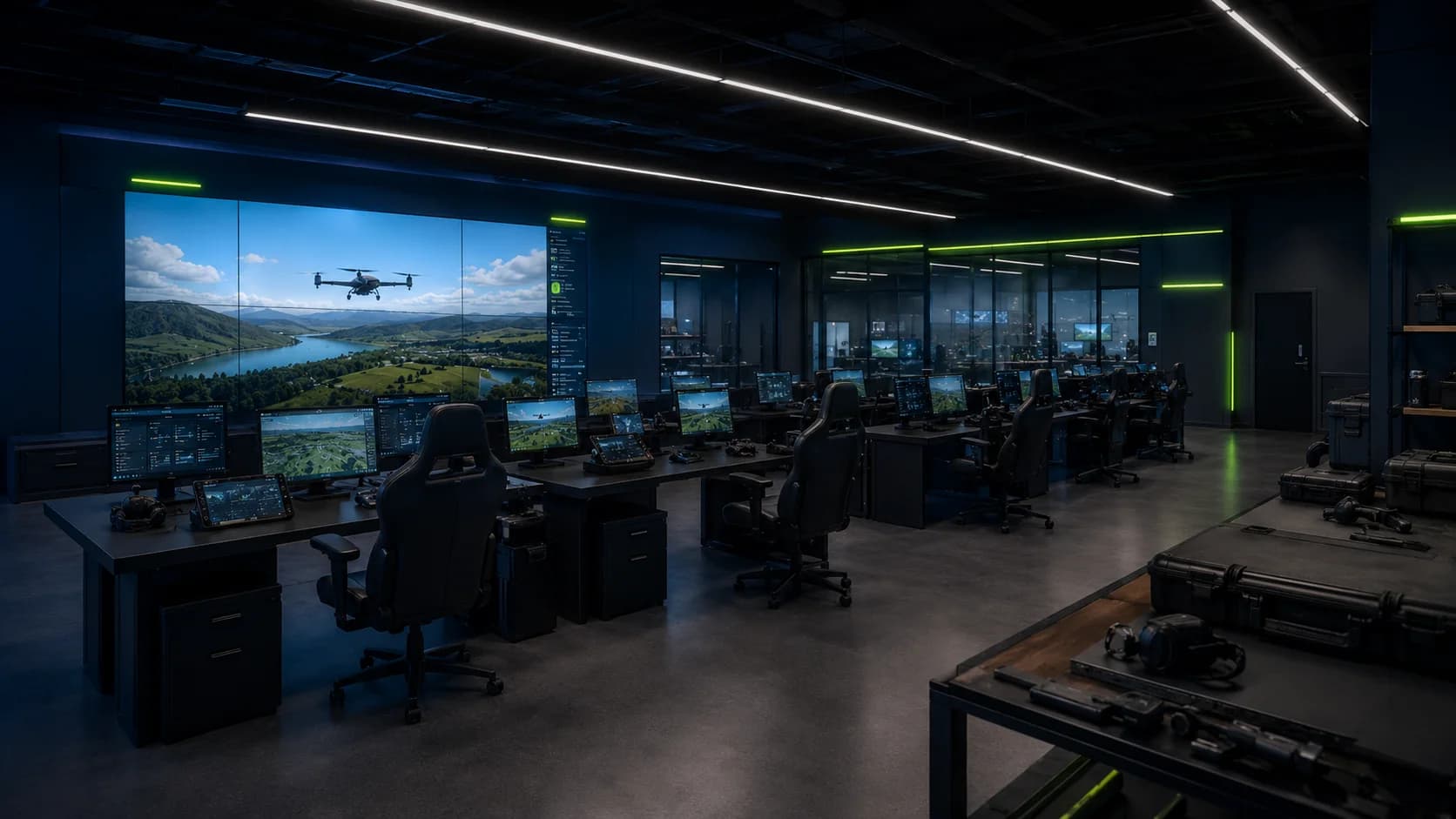
The strength lies not in one device, but in the connection between simulators, scenarios, roles, shared information, and facilitation.
Modules are selected and combined based on the objective, location, and intended experience.
Realistic controls and repeatable flight situations.
Direct camera view for navigation and orientation.
Experience scenarios from additional perspectives and roles.
Prepare routes, objectives, roles, and decision points.
Coordinate information and actions from a shared mission picture.
Review progress, observations, and scenario information together.
Use actions and experiences for guided reflection.
More than learning to fly
The technology enables the experience. Development comes from what participants observe, discuss, decide, and improve together.
Identify relevant information and maintain oversight as conditions change.
Exchange information between roles concisely, clearly, and purposefully.
Substantiate decisions, observe consequences, and adjust the approach in time.
Understand how systems, controls, and mission processes affect one another.
Review teamwork and execution to improve the next round.
Versatile applications
The same modular foundation can take on a different form and content when the target group, context, or program objective changes.
For orientation, guided training, and technology demonstrations in a controlled simulation environment.
Explore applications for Defense and securityFor career orientation, technology education, and hands-on programs at secondary vocational and higher-education levels.
Explore the education applicationFor events, open days, and programs where participants experience modern mission technology firsthand.
Discuss a demonstrationScalable for each location
A Mission Lab does not need to be a complete permanent facility from day one. The setup can match the available space and be adapted or expanded later.
A portable configuration for demonstrations, events, and temporary programs.
A permanent setup in an existing classroom, innovation center, or training environment.
A complete environment with multiple stations, briefing facilities, shared visualization, and facilitation.
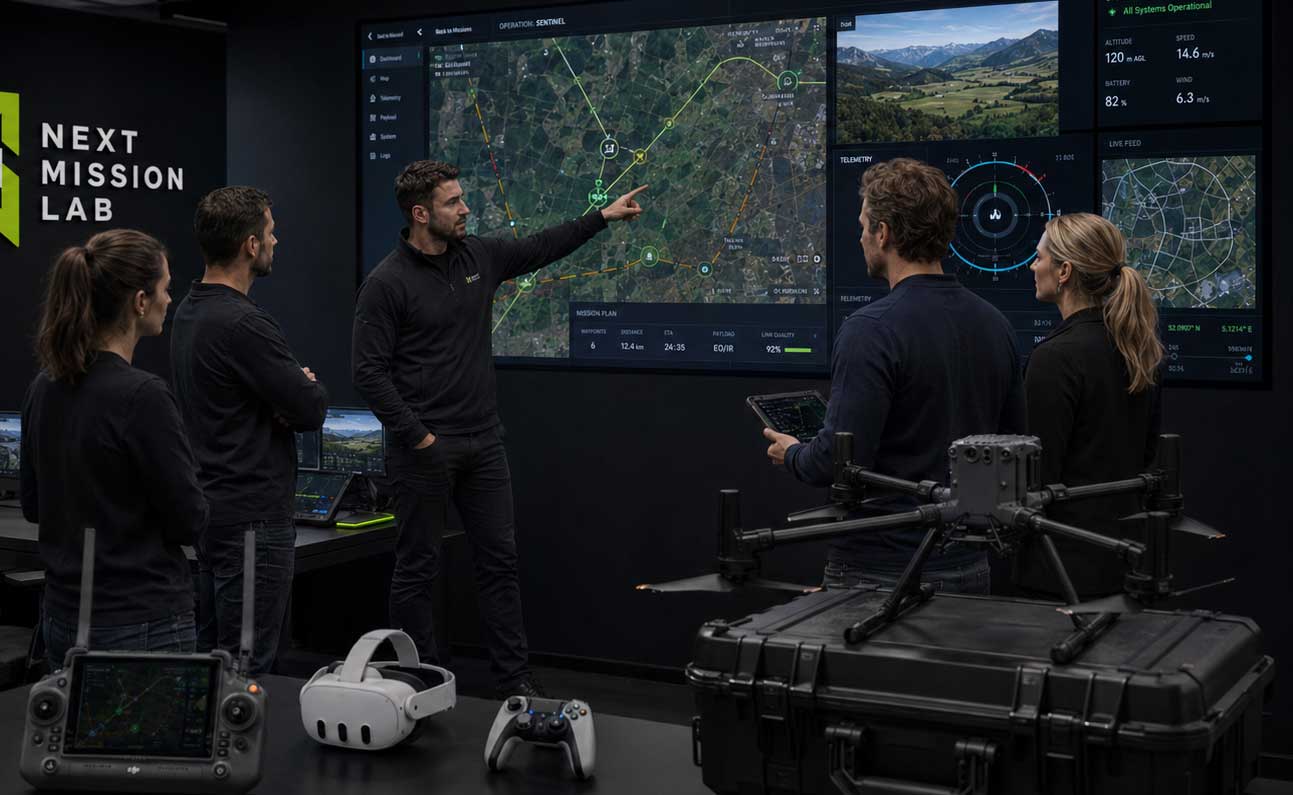
From objective to operation
We connect the setup to a program, the right facilitation, and a method for evaluating experiences. A focused pilot can make assumptions testable first.
Define the objective, target group, and application
Design the space, technology, and configuration
Develop scenarios and the facilitation approach
Prepare facilitators and commission the environment
Evaluate delivery and determine next steps
Tailored configuration
Drone Mission Lab is configured around your objectives, target group, and operating context. Our proposal specifies how modules, scenarios, facilitation, and evaluation come together in a suitable, achievable solution.
Discuss your target group, location, and program, or schedule a demonstration of the concept first.